Showing posts with label Indian wildlife butterflies pupa wildscapes urban wildlife. Show all posts
Showing posts with label Indian wildlife butterflies pupa wildscapes urban wildlife. Show all posts
Thursday, September 23, 2010
Kanha National Park
Here is a very economical offer to visit Kanha National Park in Madhya Pradesh!
Three days standard itinerary
2 Nights/ 3 days stay charges
Plus
Meals (Breakfast-Lunch-Dinner)
Pick up and drop facility from Gondia Station and back
Two visits to Kanha National Park
Rs 18400/- per batch of six persons
This offer is courtesy Kanha Village Camp


Sunday, March 21, 2010
World Housesparrow Day
Why celebrate a house sparrow day? Because, the lowly but sturdy sparrows are a good indicator of bio diversity and their decline in urban areas is proof that we have succumbed to chemical fertilizers and pesticides, not only in agricultural fields which are around us but also in the small kitchen gardens next to our homes.

20th March 2010 was celebrated as the first Worldhousesparrowday. Delhi Chief Minister Sheila Dixit unveiled a nest box for sparrows made by "NatureForever" while Mr. Asad Rahmani of BNHS looked on.

That the Chief Minister of Delhi spared time for the cause is proof that organic gardens in and around our homes must show the way for sparrows. The CM herself has converted the compound of her bungalow to a "Green Canopy" open to public for nature trails. Fruit bats outside the CM's house kept a caophony going at the inaugural function held at her residence.

Write-up about fruit bats at the interpretation Centre at 3, Motilal Nehru Place
Mrs. Barack Obama hosting organic lunches for children from produce of her kitchen garden made news recently. Realization is dawning worldwide that we need to say no to chemical fertilizers and pesticides, to protect ourselves, if not the sparrows. Sparrows are but an indicator of what is in store for our future generations.

The vermi compost pit

Sheila Dixit's organic garden

Ms Lima Rosalind explaining the digital kiosk at the interpretation centre to a visitor.

20th March 2010 was celebrated as the first Worldhousesparrowday. Delhi Chief Minister Sheila Dixit unveiled a nest box for sparrows made by "NatureForever" while Mr. Asad Rahmani of BNHS looked on.

That the Chief Minister of Delhi spared time for the cause is proof that organic gardens in and around our homes must show the way for sparrows. The CM herself has converted the compound of her bungalow to a "Green Canopy" open to public for nature trails. Fruit bats outside the CM's house kept a caophony going at the inaugural function held at her residence.

Write-up about fruit bats at the interpretation Centre at 3, Motilal Nehru Place
Mrs. Barack Obama hosting organic lunches for children from produce of her kitchen garden made news recently. Realization is dawning worldwide that we need to say no to chemical fertilizers and pesticides, to protect ourselves, if not the sparrows. Sparrows are but an indicator of what is in store for our future generations.

The vermi compost pit

Sheila Dixit's organic garden

Ms Lima Rosalind explaining the digital kiosk at the interpretation centre to a visitor.
Wednesday, October 21, 2009
Urban Wildlife-Colours of autumn
I am opening this blog with a natural flower arrangement from my garden. Kanahs and roses seem to like autumn best.

The lime butterflies are common

So are the plain tigers.

The grass blue is fashionably judicious in the use of bright colours for that graceful effect.

Turn on your macro lens and whole new worlds open up, like this lady bug in mustard color with a beautiful pattern on her duppatta!


The lime butterflies are common

So are the plain tigers.

The grass blue is fashionably judicious in the use of bright colours for that graceful effect.

Turn on your macro lens and whole new worlds open up, like this lady bug in mustard color with a beautiful pattern on her duppatta!

Friday, October 2, 2009
Moth on a shrivelled nest

The photograph above shows a moth resting on the shrivelled nest of an ashy prinia warbler. The leaves are of the creeper "flaming glory bower'.
I have just written a blog on the caterpillar I found on the leaves of the elephant foot yam plant.
Can some one identify whether the moth has metamorphosed from the caterpillar shown? Or are they from different species?
Wednesday, September 30, 2009
'Instars' after the rains!
This year the rains came late and lingered till end of August. The butterflies and moth caterpillars waste no time in completing their life cycles; Here are some I managed capturing on the lens, in the beginning of September.

The above picture is that of a lime butterfly caterpillar which is probably in its third stage (instar)of moulting. The picture below is that of the same caterpillar after two more moultings. Now it is in its last 'instar' and the next stage will be the pupa and then the lime butterfly. The host plant is the Chinese Orange tree.

If the caterpillars of lime butterfly are fast eaters, they pale in comparison with the moth caterpillar's eating capacity. The picture below is that of the Elephant Yam moth caterpillar. This one could devour huge leaves of the yam plant overnight and was found hiding beneath the leaf during the day. I could not observe this caterpillar in its next stage; probably a mynah or babbler found this packaged fast food irresistible. The caterpillar disappeared sometime during the day.


The above picture is that of a lime butterfly caterpillar which is probably in its third stage (instar)of moulting. The picture below is that of the same caterpillar after two more moultings. Now it is in its last 'instar' and the next stage will be the pupa and then the lime butterfly. The host plant is the Chinese Orange tree.

If the caterpillars of lime butterfly are fast eaters, they pale in comparison with the moth caterpillar's eating capacity. The picture below is that of the Elephant Yam moth caterpillar. This one could devour huge leaves of the yam plant overnight and was found hiding beneath the leaf during the day. I could not observe this caterpillar in its next stage; probably a mynah or babbler found this packaged fast food irresistible. The caterpillar disappeared sometime during the day.

Wednesday, July 22, 2009
Monsoon Raindrops
This year Gurgaon and entire Haryana is experiencing the monsoon in "Raindrops" and not sheets of rain like it did last year.

The promising clouds disappeared as soon as a few drops fell into the earth. Even the jade plant who does not need much water to grow seemed to treasure them like jewels!

The yellow lilies I planted two years ago bloomed all on a sudden as if to welcome the rain with open arms!


The promising clouds disappeared as soon as a few drops fell into the earth. Even the jade plant who does not need much water to grow seemed to treasure them like jewels!

The yellow lilies I planted two years ago bloomed all on a sudden as if to welcome the rain with open arms!

Sunday, March 29, 2009
Visiting the ski slopes of Auli - The Treks
The treks
R.R Point
Absence of snow at Auli had a silver lining to it. We could go for small treks around the place with our normal trekking shoes. The easiest trek was just 1.5 km, to R.R Point, an army communication center.

From R.R point one could see the Hemkunt range and the Valley of flowers enveloped in clouds far away. Immediately below is a village, which is shaped like the map of India.
India map village against rhododendron flowers blooming in February

Gorson Bugyal 3.5km
Many ventured on this trek as Gorson meadow had a patch of hard snow where one could get basic lessons in skiing.
Gorson from the hotel

Bharati, a black dog and Sheru a brown dog faithfully accompanied us on all treks. In the pic below, Sheru waits patiently for the tekkers to catch up while Bharati is following us close on the heels. The feeling of oneness with nature one experiences on treks is reinforced by these two best friends of man.
Sheru and Bharati

This trek is indeed beautiful. A temple called “Padiyar Devta’greets you half way up the climb.

As we near Gorson point, one is within reach of the snow clad peaks.

Beyond Gorson

The Forest Trek- 4km
This trek through steep golden oak forest is rated as difficult-mainly because the climb is continiuosly steep without plain resting spots. It is made tougher these days since one has to climb up the ski slopes- now being shorn of grasses and bushes thanks to the bull dozer razing through it many times to create the artificial ski slope.

As we neared the golden oak trees, we saw some with huge cavernous holes ( Black bears sleep there, our guide informed). Fresh diggings in the mud were attributed to wild boar. Distant trees moved with the weight of animals or birds flying about-monkeys or Himalyan monals? Here is the lichen with which monals make nests on trees, our guide showed a clump on the ground

As we moved down I collected a few branches of golden oak leaves. The trees marked with the "death warrants" continue to haunt me when I look at these leaves dried but golden, weeping silently in my vase.

More on the destruction of the forest in my next blog!
R.R Point
Absence of snow at Auli had a silver lining to it. We could go for small treks around the place with our normal trekking shoes. The easiest trek was just 1.5 km, to R.R Point, an army communication center.

From R.R point one could see the Hemkunt range and the Valley of flowers enveloped in clouds far away. Immediately below is a village, which is shaped like the map of India.
India map village against rhododendron flowers blooming in February

Gorson Bugyal 3.5km
Many ventured on this trek as Gorson meadow had a patch of hard snow where one could get basic lessons in skiing.
Gorson from the hotel

Bharati, a black dog and Sheru a brown dog faithfully accompanied us on all treks. In the pic below, Sheru waits patiently for the tekkers to catch up while Bharati is following us close on the heels. The feeling of oneness with nature one experiences on treks is reinforced by these two best friends of man.
Sheru and Bharati

This trek is indeed beautiful. A temple called “Padiyar Devta’greets you half way up the climb.

As we near Gorson point, one is within reach of the snow clad peaks.

Beyond Gorson

The Forest Trek- 4km
This trek through steep golden oak forest is rated as difficult-mainly because the climb is continiuosly steep without plain resting spots. It is made tougher these days since one has to climb up the ski slopes- now being shorn of grasses and bushes thanks to the bull dozer razing through it many times to create the artificial ski slope.

As we neared the golden oak trees, we saw some with huge cavernous holes ( Black bears sleep there, our guide informed). Fresh diggings in the mud were attributed to wild boar. Distant trees moved with the weight of animals or birds flying about-monkeys or Himalyan monals? Here is the lichen with which monals make nests on trees, our guide showed a clump on the ground

As we moved down I collected a few branches of golden oak leaves. The trees marked with the "death warrants" continue to haunt me when I look at these leaves dried but golden, weeping silently in my vase.

More on the destruction of the forest in my next blog!
Sunday, March 22, 2009
Visiting the ski slopes of Auli in 2009-A different experience
I have divided this photo blog into four parts
1. The mountain and the snow
2. The Flora
3. The treks
4. The destruction
The mountain and the snow
When you reach the lap of Nanda Devi, height 25,643 feet and second only to the Everest, you are overwhelmed.
Nanda Devi Peak

The nearest mountain ranges of Dronagiri seem bare, stripped of snow, in the peak of winter.
Dronagiri

The Brahmkamal peak with spikes resembling the actual flower is an instant hit.
Brahmakamal Range

So is Hathi Ghoda Palki with the glaciers clearly visible. But we came here to see and feel snow. Where are the snowflakes? On 24 February, it snowed for nearly fifteen minutes. Our new friend from the hotel wrote in her diary
" Snowflakes-some slow, some fast, some feisty doing a jig before succumbing to gravity...."
Honeymooning couples danced on the terrace in the snow

Sunrise on Nanda Devi-a picture I laboured to get right on a cold morning at 6.30 am
Sunrise at Nanda Devi

1. The mountain and the snow
2. The Flora
3. The treks
4. The destruction
The mountain and the snow
When you reach the lap of Nanda Devi, height 25,643 feet and second only to the Everest, you are overwhelmed.
Nanda Devi Peak

The nearest mountain ranges of Dronagiri seem bare, stripped of snow, in the peak of winter.
Dronagiri

The Brahmkamal peak with spikes resembling the actual flower is an instant hit.
Brahmakamal Range

So is Hathi Ghoda Palki with the glaciers clearly visible. But we came here to see and feel snow. Where are the snowflakes? On 24 February, it snowed for nearly fifteen minutes. Our new friend from the hotel wrote in her diary
" Snowflakes-some slow, some fast, some feisty doing a jig before succumbing to gravity...."
Honeymooning couples danced on the terrace in the snow

Sunrise on Nanda Devi-a picture I laboured to get right on a cold morning at 6.30 am
Sunrise at Nanda Devi

Sunday, October 21, 2007
Urban Wildlife
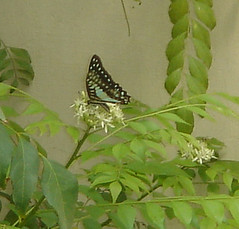
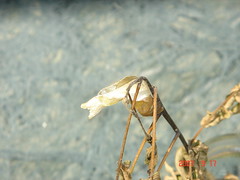
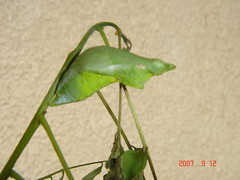
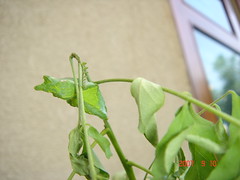
Observing around the tiny green space around the house can be rewarding for a wildlife lover. Here is something whic fascinated me for over two weeks.
Can you make out the pupa on the curry leaves branch? It is shaped and coloured like a curry leaf.
The second photo is a close up of the pupa.
The third one is the empty pupa. Though I kept observing the branch everyday for more than 10 days, the butterfly flew away early morning one day leaving the empty cocoon for me to document. I could not verify what the butterfly (the pupa could be that of a moth too) waslike, when it spread its wings and flew away.
I am also including the pic of a commonly seen butterfly which sits on the curry leaves tree. May be this is the butterfly whose metamorphosis I witnessed!
Subscribe to:
Posts (Atom)